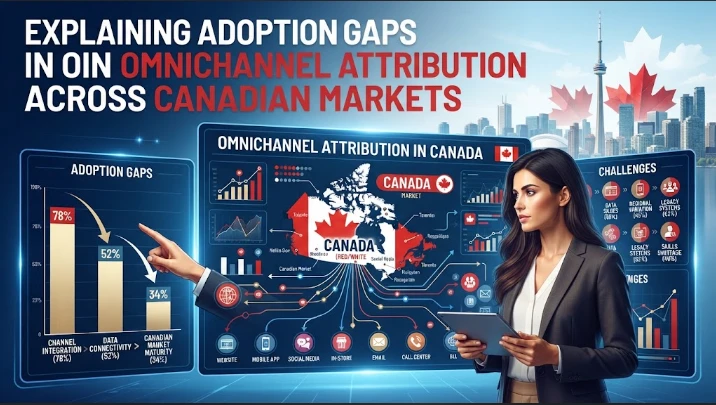
This article compares human and algorithmic decision making for Omnichannel Attribution in Canadian Markets, focusing on downstream decision quality rather than prediction accuracy alone. It estimates how online and offline touchpoints contribute to conversion, while identity gaps, walled-garden platforms and the difference between observed credit and causal incrementality complicate interpretation. Human judgment contributes context, tacit knowledge, strategic interpretation and sensitivity to unusual cases, while algorithms contribute scale, repeatability and pattern recognition but depend heavily on data quality, target definitions and design assumptions. A fair comparison therefore requires matched tasks, comparable information and the same outcome horizon. The article emphasizes hybrid decision systems in which automation handles volume and specialists address ambiguity, exceptions and weakly observed context under clear escalation rules. Incremental value, error cost, fairness, stability, timeliness and disagreement analysis are recommended for identifying the strongest decision architecture under realistic constraints.
Canada has shifted its focus from omnichannel attribution as a specialist analytics conversation to a management conversation by 21 July 2026. The question now was not whether advanced models could get scores, forecasts, rankings or recommendations, but rather whether they can give them in a convenient manner. More and more focus shifted to questions of the reliability and readability of such outputs, fairness, and economic utility. As organizations invest in omnichannel attribution, it became more important than just performing a technical job, it became a job of evidence-based decision quality. Omnichannel attribution is an effort to understand the impact of different online/offline touchpoints on conversion or any other business goal.
Canadian markets introduce additional practical considerations such as privacy concerns, channel dependence, retail differences, language issues, and the divergent nature of digital and physical channel integration. Identity resolution can become brittle, or journeys can be limited by walled-garden platforms, when you use attribution models. The benefit of incrementality testing is that observed credit does not necessarily equal causal contribution, and that there is a significant safety to this component. If one is using a human judgment, the other must be using a computer judgment. Human judgment is not only context-aware, tacit knowledge, empathetic, and strategically based, but also inconsistent, fatigued, and anchored, and selectively attuned, etc. Algorithms are the things that provide scale, repeatability and pattern recognition, but require data quality, target definitions, training history and design assumptions.
Matched tasks matched under matched conditions are the subjects of a fair comparison. In addition to the prediction level, assessment should be done at the decision level. Budget, attention, workflow, or customer treatment would be impacted by a subsequent action and this is why an attribution score, engagement signal, or platform metric matters. Incremental value, calibration, error cost, fairness, stability and sensitivity to change can therefore be used as a basis for comparing the human and algorithmic approaches. Hybrid decision systems may require attention in particular. Algorithms can analyze a great deal of signals and human experts can analyze unusual cases, context, and factors that are not so well observed.
The most robust hybrid design rules out the nature of the automation that leads, the human review that is required, and the disagreement's implications that warrant further investigation. It's quite possible for a hybrid system to grow slower without growing wiser without those rules. Evaluation also must be able to tell between consistency and correctness. The algorithm will make the same error repeatedly, and human teams will find that different teams can arrive at different conclusions for similar cases. While consistency is important for scale and governance, consistent error is still a problem for value. Sometimes there is real ambiguity that emerges in human variation that a model will hide.
Belief is to be based on proof, not on familiarity. Decision makers may be too much on the credit of polished dashboards or too much on the credit of long-bred intuition. Blind Tests, Retrospective Backtest, Randomised Trials, Calibration Exercises, and Disagreement Analysis can reveal advantages on both sides. The goal is to determine the winning decision architecture under realistic constraints, not to figure out what decision architecture is best for everyone. Canadian analytics governance integrated private-sector privacy requirements with more and more public-sector regulations on automated decision-making. Structured Assessment was a tangible benchmark for responsible automation with the federal Directive on Automated Decision-Making, which mandated impact assessment and risk-based safeguards for systems covered by it.
The Office of the Privacy Commissioner of Canada reiterated that software is not the basis for an organization's responsibility for a decision, just because it is part of a computer-based decision-making process. Explicit uncertainty communication is also a part of strong analysis practice. Point estimates can lead to false precision, particularly when the data coverage is sparse, or when conditions vary rapidly. Uncertainty becomes visible to the operational teams through prediction intervals, sensitivity ranges, scenario analysis, and confidence categories. Use of uncertainty language will help participants make proportional responses to the questions rather than accepting all scores. Equally, the governance of vendors should be considered as it is possible for them to change models, interfaces, data processing or terms without equivalent internal release cycles.
The following issues should be covered in contracts: documentation, change notification, audit access, incident response, security, data retention and exit arrangements. Independent validation is still required with internal teams due to vendor assurance being not sufficient to replace the need for organization specific evidence. The value of a business should be determined throughout the business life cycle. Development costs are not the only costs; integration, training, monitoring, data maintenance, review time, remediation and retirement are other costs. The costs that reoccur should be compared against the benefits. A model which requires frequent manual tuning may appear good in pilot trials but produce a poor net value after scaling. Monitoring results and incorporating them into the design of the process results in a significant source of return for organizational learning.
When the frontline judgment and the data do not agree, it can reveal variables that are not included or rules that are obsolete. A series of model errors can identify problems with labels or business definitions. It is a more powerful decision system than just retraining regularly because those signals are used as learning opportunities. To the extent that they impact on omnichannel attribution, business unit, customer group, geography, channel and operating regime should also be segmented. Shared metric definitions and data dictionaries help minimize disagreements, which can only be resolved once performance starts to suffer. The key is that, when you do a baseline comparison, you might not see any apparent improvement in omnichannel attribution, even though it appears to have occurred.
Independent review is most helpful when reviewers can generate the important results from the raw inputs, assumptions that are documented, and the version-controlled artifacts (code, model, etc.). Instead of a large dashboard with no clear escalation logic, operational teams are provided with a few key indicators which help in making decisions. Rare combinations, missing inputs, abrupt volume changes, and unfamiliar cases can all be the impetus for brittle behavior in systems before deployment, and scenario testing can uncover those characteristics. Shared metric definitions and data dictionaries help minimize disagreements, which can only be resolved once performance starts to suffer. Average performance and tail outcomes should be monitored as both will be of greater concern when errors are large.
Independent review is most effective if the reviewer can be able to recreate the important findings from the raw inputs, recorded assumptions, and from version controlled code and/or model artefacts. Change management also requires users at the front-end as any reduction in the value realized due to workflow friction will do so despite the analytical performance remaining unchanged. Rare combinations, missing inputs, abrupt volume changes, and unfamiliar cases can all be the impetus for brittle behavior in systems before deployment, and scenario testing can uncover those characteristics. It is important to have an explicit retirement rule since obsolete models can survive in the organization due to inertia even when there is evidence of their need to be replaced.
Average performance should be monitored and tail outcomes should be monitored as well; often a large number of errors are of great consequence. Decision Logs can provide useful evidence for review at a later date and help to connect recommendations, overrides, context, and outcomes. Change management also requires users at the front-end as any reduction in the value realized due to workflow friction will do so despite the analytical performance remaining unchanged. Whereas the basic definition of cost sensitive evaluation is to assign varying consequences to false positives, false negatives, delayed action, and unnecessary escalation, it improves realism. A clear retirement rule is important because there can be lots of organizational inertia that leaves behind obsolete models even though the evidence is there to be replaced.
Periodic challenge exercises can be used to see if a simpler rule, the new baseline or another model would be better at the current time than the current system. Decision logs serve as a valuable piece of evidence that will be reviewed at a later stage and will link recommendations, overrides, contextual reasons, and actual outcomes. To the extent that they impact on omnichannel attribution, business unit, customer group, geography, channel and operating regime should also be segmented. Evaluation is made cost sensitive to improve realism, by assigning varying consequences for false positive, false negative, delayed action and unnecessary escalation. The key is that, when you do a baseline comparison, you might not see any apparent improvement in omnichannel attribution, even though it appears to have occurred.
In Canada, this battle between marketing humans and algorithms in omnichannel attribution is a lose-lose situation, as there's no single winner. Task-specific design, explicit comparison, and carefully-framed hybrid workflows suggest themselves as evidence. Realizing better decisions when strengths and failure modes on both sides are measured on the same terms and relate to business outcomes.
CITE THIS ARTICLE
CHOWDHURY, S. A. (2026). Comparing Human and Algorithmic Decisions for Omnichannel Attribution in Canadian Markets. https://www.sabbirresearchhub.com/article/bcd4ea36-5acf-5a6a-851f-9fec62384280
S. A. CHOWDHURY, “Comparing Human and Algorithmic Decisions for Omnichannel Attribution in Canadian Markets,” 2026. [Online]. Available: https://www.sabbirresearchhub.com/article/bcd4ea36-5acf-5a6a-851f-9fec62384280
CHOWDHURY, S. A. (2026) ‘Comparing Human and Algorithmic Decisions for Omnichannel Attribution in Canadian Markets’. Available at: https://www.sabbirresearchhub.com/article/bcd4ea36-5acf-5a6a-851f-9fec62384280
CHOWDHURY, SABBIR AHMED. “Comparing Human and Algorithmic Decisions for Omnichannel Attribution in Canadian Markets.” 2026, https://www.sabbirresearchhub.com/article/bcd4ea36-5acf-5a6a-851f-9fec62384280.
SABBIR AHMED CHOWDHURY. “Comparing Human and Algorithmic Decisions for Omnichannel Attribution in Canadian Markets.” (2026). https://www.sabbirresearchhub.com/article/bcd4ea36-5acf-5a6a-851f-9fec62384280.
CHOWDHURY SA. Comparing Human and Algorithmic Decisions for Omnichannel Attribution in Canadian Markets. 2026. https://www.sabbirresearchhub.com/article/bcd4ea36-5acf-5a6a-851f-9fec62384280
@misc{article_bcd4ea365acf5a6a851f9fec62384280,
  title = {Comparing Human and Algorithmic Decisions for Omnichannel Attribution in Canadian Markets},
  author = {SABBIR AHMED CHOWDHURY},
  year = {2026},
  url = {https://www.sabbirresearchhub.com/article/bcd4ea36-5acf-5a6a-851f-9fec62384280},
}
TY  - GEN
AU  - SABBIR AHMED CHOWDHURY
TI  - Comparing Human and Algorithmic Decisions for Omnichannel Attribution in Canadian Markets
PY  - 2026-07-21
UR  - https://www.sabbirresearchhub.com/article/bcd4ea36-5acf-5a6a-851f-9fec62384280
ER  -
AI-enabled employee engagement includes survey analytics, sentiment analysis, personalized recommendations, workforce listening, communication tools, and manager decision support, all operating within sensitive employment relationships. The article compares humans and algorithms on matched tasks, information, and outcome horizons rather than benchmark scores alone. Human context and judgment are weighed against algorithmic scale and repeatability, while hybrid rules, disagreement analysis, blind
AI business model renewal concerns changes in value creation, value delivery, and value capture through AI-enabled services, workflow redesign, personalization, pricing support, and new information products. The article emphasizes real-world causal testing through random assignment, phased rollouts, encouragement designs, or cluster experiments. It calls for pre-specified outcomes, contamination controls, comparisons among human-only, algorithm-only, and hybrid workflows, and stop rules when har
This article explains uneven adoption of Omnichannel Attribution across Canadian Markets, arguing that differences in capability and readiness matter as much as enthusiasm for new technology. It estimates how online and offline touchpoints contribute to conversion, while identity gaps, walled-garden platforms and the difference between observed credit and causal incrementality complicate interpretation. Larger or more mature organizations can invest in data engineering, experimentation, governan