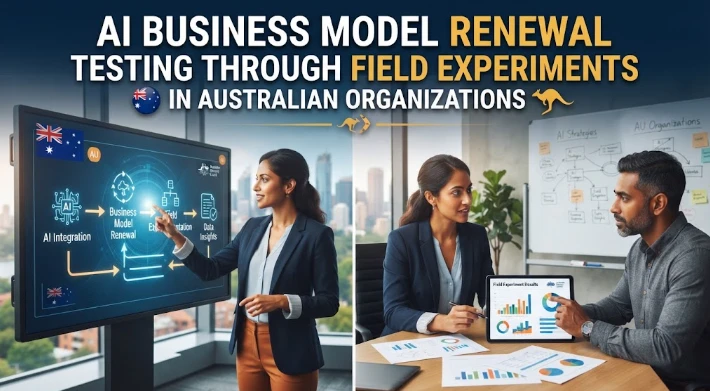
AI business model renewal concerns changes in value creation, value delivery, and value capture through AI-enabled services, workflow redesign, personalization, pricing support, and new information products. The article emphasizes real-world causal testing through random assignment, phased rollouts, encouragement designs, or cluster experiments. It calls for pre-specified outcomes, contamination controls, comparisons among human-only, algorithm-only, and hybrid workflows, and stop rules when harm, security problems, or operational deterioration appear. The Australian discussion connects AI use with Privacy Act obligations, anti-discrimination responsibilities, human oversight, and concerns about unfair outcomes from biased data, proxies, or design choices. Across the analysis, business value is tied to baselines, uncertainty, subgroup effects, workflow fit, lifecycle cost, vendor accountability, scenario testing, and decision records. The overall message is that analytical performance becomes credible only when it improves real decisions under clearly defined operating and governance conditions. Independent review, common metric definitions, and periodic challenge exercises are also presented as safeguards against hidden deterioration, stale assumptions, and continued use of systems that no longer justify their cost or risk.
In Australia, the use of AI in business model renewal has progressed from a specialist analytics discussion to a management question by 02 June 2026. What was no longer in question was whether or not advanced models can produce scores, forecasts, rankings or recommendations. A focus increasingly was placed on whether those outputs were reliable, understandable, fair, and economically useful when linked to real choices. For organisations focused on AI business model renewal, that shift will create a new definition for successful AI implementation, beyond just technical performance—it will be to demonstrate that AI is improving business decision-making. AI business model renewal is about the change in value creation, value delivery and value capture, not about automating a task.
A business-model hypothesis that can be portrayed in a bounded operational treatment turns into a valuable field experiment. Australian organizations can deploy AI-powered service models, workflow redesign, personalisation, pricing support, or new information products at a limited scale and then scale them up if they prove successful. This experimentation diminishes the need for speculative transformation stories. Field experiments are experiments conducted in real operating conditions rather than in a laboratory setting, which means they have high-powered evidence. The problem can be addressed by careful design of random assignment, phased rollouts, encouragement designs, or cluster experiments. The big challenge is maintaining the rigor of experiments without interfering with critical business processes.
A believable experiment starts with a focused question. Treatment should be a specific change, such as an algorithm-assisted screening process, an updated algorithm to recommend treatment, an alert predicting when treatment is needed, or an AI-driven workflow. Outcomes should be identified prior to analysis and include both positive and potential negative outcomes. Productivity may be missing fairness, quality, employee response, customer effects, or downstream rework. The danger of contamination must be avoided in the randomization process. Managers can broadcast recommendations to other treatment groups, employees can adapt their behavior based on the learning they receive about the experiment and operational teams can override assigned treatments. The interpretability is maintained through pre-registration, clear treatment protocols, audit logs, and intention-to-treat analysis.
When people interact closely, cluster designs can also help to minimise spillovers. Field experiments should make an apples-to-apples comparison between more than automation versus no automation. Helpful designs can include comparisons between decisions made by humans, decisions made by algorithms (where appropriate), and algorithm-assisted human decisions. These comparisons show if there is value found in prediction, consistency, speed, or complementarity. Interaction data can also provide information on the amount of time taken to correct model weaknesses and the amount of human variance added to the model. Ethics and governance continue to be at the heart of all things. There should be no hidden or undue material risk for participants for experimental convenience and protected groups need special monitoring of outcomes.
Experiments with personal data should be based on lawful data handling and proportional data collection. There should be a stop rule for convincing evidence of harm, security failure or unacceptable operational deterioration. National discussion on tougher regulations for high impact artificial intelligence continued, as Australian organisations were subject to existing anti-discrimination responsibilities and privacy regulations. In 2024, the Office of the Australian Information Commissioner (OAIC) issued guidance indicating the Privacy Act would apply to AI products that rely on personal information, and highlighting the need for privacy governance. The Australian Human Rights Commission also raised concerns about the potential for discrimination in algorithmic decision-making processes and created compliance guidance for employers.
Communication of uncertainty is also required for good analytical practice. Point estimates can lead to an apparent precision that is often false, particularly where data are limited or the situation is rapidly evolving. Uncertainty is made visible to operational teams through prediction intervals, sensitivity ranges, scenario analysis and confidence categories. Clear uncertainty language helps to promote proportional responses and not automatic scores for all uncertainty levels. Vendor governance is equally important since external platforms can also change their models, interfaces, data processing and/or terms without following the same release cycles as the internal systems. These should be covered in contracts: documentation, change notification, audit access, incident handling, security, data retention, exit arrangements.
However, independent evidence on the internal teams is still required as vendor assurance is not a replacement. Business value needs to be assessed throughout the business lifecycle. Development is just the start; integration, training, monitoring, data maintenance, review time, remediation and retirement require resources as well. Those benefits should be compared to those recurring costs. Highly manual model can be very neat for a pilot and can yield poor net value after scale. When results are fed back to process design, organizational learning is a key source of return. When there is constant disagreement between data and front line judgment, it can reveal missing variables and/or old rules. Errors in the model can be identified when repeated.
Using those signals as learning opportunities yields a more powerful decision-making system than just simply retraining on schedule. Evidence should also be broken down by business unit, by customer group, by geography, by channel or by operating regime if those divisions impact AI business model renewal. Reducing the disputes that arise after performance starts to show signs of deterioration, with data dictionaries and shared metric definitions. Comparisons at baseline are important because, if seasonal factors, policy changes or previous trends are considered, improvement in the apparent business model of the AI may not be maintained. Independent review is most helpful when reviewers can replicate some of the key results from the raw inputs and documented assumptions and version controlled model and/or code artifacts.
Operational teams have a limited number of indicators that they can use to make decisions, instead of a large dashboard with no escalation logic. However, scenario testing can reveal brittle behavior prior to deployment by presenting systems with unusual combinations, omitting inputs, sudden changes in volume, or unexpected cases. Shared metric definitions and data dictionaries help prevent conflicts that can only arise when performance starts to suffer. Average performance and tail outcomes should be monitored as errors that are severe have greater importance than errors that are only modest. Independent review is best when the reviewers can be able to reproduce important results, based on the raw data, assumptions documented and version-controlled code or model artifacts.
Feedback from the frontline user is also required for change management, because workflow friction can also negatively impact the realized value, even if analytical performance is unchanged. It can be useful to find out if your system is brittle by subjecting it to scenario testing, which forces it to deal with rare combinations, missing input, sudden volume changes, or unusual cases before it's deployed. Because it takes time for an organization to change, there is a need for a retirement rule that will be clear. Average performance and tail outcomes should be monitored; some big mistakes can be much more important than some small improvement in an average figure. Decision logs generate useful evidence for future consideration, connecting recommendations, overrides, context and realized consequences.
Feedback from frontline users is also critical for change management – if workflow friction is a concern, even if the analytical performance is acceptable, realized value is diminished. Cost-sensitive evaluation helps to produce realism, as a consequence of a false positive is evaluated differently than a false negative, delayed action, and unnecessary escalation. The importance of a clear retirement rule: A rule for retirement is necessary because otherwise, the organization may continue to follow old models despite evidence for their unfeasibility. To determine if a simpler rule, new baseline, or new model can outperform the current rule, periodic test exercises can be conducted. Decision logs provide evidence that can be reviewed later to connect recommendations, overrides, context for the decision and the realized outcome.
Segments of evidence should also be by business unit, customer group, geography, channel or operating regime when these segments have an impact on AI business model renewal. Cost-sensitive evaluation adds realism, assigning false positive, false negative, delayed action, and unnecessary escalation consequences to the types of results. Comparisons to baseline are important because seasonalities, policy changes, or previous trends can make apparent improvements in AI business model renewal vanish. While transformation is a risky prospect, Field experimentation can provide a structured approach to AI business model renewal in Australia without taking a leap of faith. Controlled testing can help identify improvements in the outcomes of technology, the population benefiting from the improvements, and the groups that are adversely impacted.
Scaling should be based on replicated evidence, not enthusiasm, as the governance should be able to halt or redesign an intervention when results are not favorable.
CITE THIS ARTICLE
CHOWDHURY, S. A. (2026). Testing AI Business Model Renewal Through Field Experiments in Australian Organizations. https://www.sabbirresearchhub.com/article/294d1cb0-5f95-5461-9bbf-ea3150acc610
S. A. CHOWDHURY, “Testing AI Business Model Renewal Through Field Experiments in Australian Organizations,” 2026. [Online]. Available: https://www.sabbirresearchhub.com/article/294d1cb0-5f95-5461-9bbf-ea3150acc610
CHOWDHURY, S. A. (2026) ‘Testing AI Business Model Renewal Through Field Experiments in Australian Organizations’. Available at: https://www.sabbirresearchhub.com/article/294d1cb0-5f95-5461-9bbf-ea3150acc610
CHOWDHURY, SABBIR AHMED. “Testing AI Business Model Renewal Through Field Experiments in Australian Organizations.” 2026, https://www.sabbirresearchhub.com/article/294d1cb0-5f95-5461-9bbf-ea3150acc610.
SABBIR AHMED CHOWDHURY. “Testing AI Business Model Renewal Through Field Experiments in Australian Organizations.” (2026). https://www.sabbirresearchhub.com/article/294d1cb0-5f95-5461-9bbf-ea3150acc610.
CHOWDHURY SA. Testing AI Business Model Renewal Through Field Experiments in Australian Organizations. 2026. https://www.sabbirresearchhub.com/article/294d1cb0-5f95-5461-9bbf-ea3150acc610
@misc{article_294d1cb05f9554619bbfea3150acc610,
  title = {Testing AI Business Model Renewal Through Field Experiments in Australian Organizations},
  author = {SABBIR AHMED CHOWDHURY},
  year = {2026},
  url = {https://www.sabbirresearchhub.com/article/294d1cb0-5f95-5461-9bbf-ea3150acc610},
}
TY  - GEN
AU  - SABBIR AHMED CHOWDHURY
TI  - Testing AI Business Model Renewal Through Field Experiments in Australian Organizations
PY  - 2026-06-02
UR  - https://www.sabbirresearchhub.com/article/294d1cb0-5f95-5461-9bbf-ea3150acc610
ER  -
AI-enabled employee engagement includes survey analytics, sentiment analysis, personalized recommendations, workforce listening, communication tools, and manager decision support, all operating within sensitive employment relationships. The article compares humans and algorithms on matched tasks, information, and outcome horizons rather than benchmark scores alone. Human context and judgment are weighed against algorithmic scale and repeatability, while hybrid rules, disagreement analysis, blind
This article compares human and algorithmic decision making for Omnichannel Attribution in Canadian Markets, focusing on downstream decision quality rather than prediction accuracy alone. It estimates how online and offline touchpoints contribute to conversion, while identity gaps, walled-garden platforms and the difference between observed credit and causal incrementality complicate interpretation. Human judgment contributes context, tacit knowledge, strategic interpretation and sensitivity to
This article explains uneven adoption of Omnichannel Attribution across Canadian Markets, arguing that differences in capability and readiness matter as much as enthusiasm for new technology. It estimates how online and offline touchpoints contribute to conversion, while identity gaps, walled-garden platforms and the difference between observed credit and causal incrementality complicate interpretation. Larger or more mature organizations can invest in data engineering, experimentation, governan