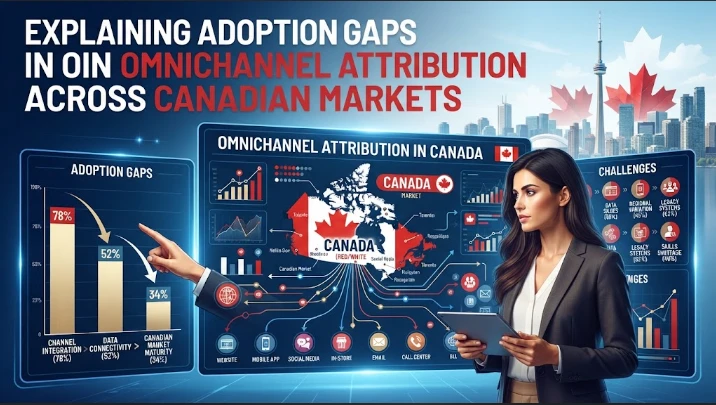
This article explains uneven adoption of Omnichannel Attribution across Canadian Markets, arguing that differences in capability and readiness matter as much as enthusiasm for new technology. It estimates how online and offline touchpoints contribute to conversion, while identity gaps, walled-garden platforms and the difference between observed credit and causal incrementality complicate interpretation. Larger or more mature organizations can invest in data engineering, experimentation, governance and specialist skills, while fragmented organizations may first need consistent identifiers, integrated systems, reliable tracking and workable analytics processes. Leadership support is important when new analytical capabilities alter incentives, decision rights, vendor relationships or managerial autonomy, but sponsorship without evidence can also accelerate premature scaling. Privacy and governance maturity can reduce uncertainty by clarifying consent, retention, access controls and vendor oversight. The article frames rational adoption as a balance among expected value, switching cost, readiness requirements and residual risk.
In Canada, by 07 July 2026, the conversation about omnichannel attribution had shifted away from specialist to management focus. The importance of the question was no longer if such models could score, predict, rank or make a recommendation. The question now was whether those outputs could then be trusted and understood and whether they would still be fair and economically beneficial when used in conjunction with actual decisions. For companies that have invested in omnichannel attribution, that meant that successful implementation traditionally was measured by technical performance but now was measured by quality of evidence-based decision making. Omnichannel attribution is an attempt to quantify the impact of many touch points, both online and offline, that lead to conversion or another business goal.
Canadian markets introduce further practical complexity, including privacy concerns, platform-specific considerations, retail variability, bilingual communications, and digital and physical channel integration issues. Incomplete identity resolution and walled-garden platforms can make attribution models complex and brittle. However, there is value in incrementality testing as a countervailing force to the observed credit, as this does not mean that the credit is causal. Often, adoption gaps are not due to a lack of enthusiasm for technology, but to differences in capability. While larger companies might invest in data engineering, experimentation, governance, and hire specialists, smaller companies may rely on tools or external platforms. Also, sector structure plays a role as the nature of transactions, the quantity of data involved, regulations and the customer journey vary significantly between sectors.
The impact of digital maturity on EV and the cost of implementation. Advanced models can be added with minimal impact to organizations with consistent identifiers, integrated systems, reliable event tracking, and workflows for analytics. Before fragmented organisations can get to work they need basic infrastructure work. The actual cost of an analytical tool is thus understated when it comes to readiness cost. Incentive and decision rights changes are important factors that require leadership support. An analytical capability can endanger existing expertise, vendor connections, budget control, and/or managerial independence. Senior sponsorship can eliminate roadblocks, and sponsorship without operational skills can also propel early scaling. Strategic commitment is matched to evidence gates at the points of effective leadership.
Another split is between privacy and governance capability. Advanced analytics can be assessed more confidently by companies that have well-established consent processes, data inventories and retention policies, as well as access controls and vendor oversight. Companies that don't have such bedrock are left with higher levels of uncertainty with regards to the lawfulness of their data use and reputational risk. Governance maturity may thus be used to speed up rather than curtail responsible adoption. The degree of perceived usefulness is final, and it is a measure of measurable improvement. While demonstrations and vendor benchmarks can drive initial interest, ongoing adoption requires evidence based on local data and workflows. The pilot programs should aim to set baseline, compare alternatives, estimate effort required to implement, and determine failure modes.
Rationality in adoption occurs when the expected value is greater than the switching cost and residual risk. Automated decisions and private sector privacy requirements were added to the already clear public sector rules on analytics governance in Canada.In Canada, the private sector's privacy obligations and the more explicit rules of the public sector for automated decisions were added together. Structured assessment was a visible reference point for responsible automation in response to the federal Directive on Automated Decision-Making which mandated impact assessment and risk calibrated safeguards for covered administrative systems. The Office of the Privacy Commissioner of Canada reiterated that software is not the basis for an organization's responsibility for a decision, just because it is part of a computer-based decision-making process.
Explicit uncertainty communication is necessary for good analytical practice. Point estimates can give the illusion of precision, particularly when data is sparse or there are rapidly changing circumstances. Prediction intervals, sensitivity ranges, scenario analysis and confidence categories provide a way for operational teams to make uncertainty visible. Use of uncertainty language will help participants make proportional responses to the questions rather than accepting all scores. Vendor governance is also important to consider because the external platform might change models, interfaces, data processing or even terms in an unimbalanced way with the internal release cycles. The following issues should be covered in contracts: documentation, change notification, audit access, incident response, security, data retention and exit arrangements.
Independent validation is still required with internal teams due to vendor assurance being not sufficient to replace the need for organization specific evidence. Business valuation should be done throughout the business lifecycle. Development cost is just the first cost, integration, training, monitoring, data maintenance, review time, remediation, and retirement costs are all additional costs. The costs that reoccur should be compared against the benefits. A model that requires frequent manual tweaking can seem great in the pilot, but have poor net value after scale. Effective organizational learning is a major source of returns if the outcome of monitoring is used to improve the process design. When the data and frontline judgment don't align, there are potential variables that have been overlooked or rules that are out of date.
Surprisingly, multiple mistakes in the model can expose problems in labels or business definitions. It is a more powerful decision system than just retraining regularly because those signals are used as learning opportunities. To the extent that they impact on omnichannel attribution, business unit, customer group, geography, channel and operating regime should also be segmented. Shared metric definitions and data dictionary eliminate disagreements which may only arise when performance starts to fall. It's crucial to make baseline comparisons, or your impression of success with omnichannel attribution may be a false one if you consider seasonality, policy changes and previous trends. Independent review is most effective when reviewers can recreate important results from input, assumptions (with documentation), and version-controlled model artifacts or code.
Instead of a big dashboard with no clear escalation logic, operational teams have a few indicators to make decision-related choices. Rare combinations, missing inputs, abrupt volume changes, and unfamiliar cases can all be the impetus for brittle behavior in systems before deployment, and scenario testing can uncover those characteristics. Data Dictionary and shared metric definitions minimise disputes that can only arise when performance starts to suffer. Monitoring should not only focus on average performance, but also tail outcomes, because there often are devastating errors that occur that are more important than small improvements in a mean. Independent review is best when the reviewers are able to replicate important findings from the inputs, assumptions, and version controlled code or model artifacts.
Change management also requires users at the front-end as any reduction in the value realized due to workflow friction will do so despite the analytical performance remaining unchanged. Brittle behavior can be revealed through scenario testing, which involves pushing systems into uncommon situations, missing inputs, sudden volume change or new scenarios prior to deployment. A clear rule of retirement is important because old models can end up staying in the organization's life long after evidence indicates that it should be replaced. Average performance and tail outcomes should be monitored as both will be of greater concern when errors are large. Decision logs provide valuable evidence that can be reviewed later to tie together recommendations, overrides, contextual reasons and the realized outcomes.
Change management also requires users at the front-end as any reduction in the value realized due to workflow friction will do so despite the analytical performance remaining unchanged. Whereas the basic definition of cost sensitive evaluation is to assign varying consequences to false positives, false negatives, delayed action, and unnecessary escalation, it improves realism. A clear retirement rule is important because outmoded models can be kept alive in the organization for a good deal longer than they are warranted. Periodic challenge exercises can be used to determine if there is a simpler rule, updated baseline, or different model that is more effective than the current rule. Decision logs are useful for future use when reviewing, tying together recommendations, overrides, context, and actual outcomes.
To the extent that they impact on omnichannel attribution, business unit, customer group, geography, channel and operating regime should also be segmented. Evaluation is more cost-sensitive to increase realism by varying consequences of false positives, false negatives, delayed action, and unnecessary escalation. In order to be able to compare the data, it is vital to establish baseline comparisons, as these can be wiped away when seasonal patterns, policy changes or previous trends are considered. Some challenges may be periodic in nature to determine if the simpler rule, new baseline or different model is working better than the current system. Operational teams are not burdened with an abundance of indicators, but rather a handful of indicators that are decision relevant.
Readiness, incentives, governance and evidence, therefore, play a major role in the adoption gap in omnichannel attribution across Canada as well as technology availability. The advantage of firms that have integrated data, good operating discipline, privacy maturity and measurable results from their privacy pilots is structural. Capability building is the first step in the process of sustainable adoption, and only then does expansion of the process occur when evidence exists locally that it needs to be expanded.
CITE THIS ARTICLE
CHOWDHURY, S. A. (2026). Explaining Adoption Gaps in Omnichannel Attribution Across Canadian Markets. https://www.sabbirresearchhub.com/article/64870d86-4505-5fd7-9c66-13b97cfd6cc3
S. A. CHOWDHURY, “Explaining Adoption Gaps in Omnichannel Attribution Across Canadian Markets,” 2026. [Online]. Available: https://www.sabbirresearchhub.com/article/64870d86-4505-5fd7-9c66-13b97cfd6cc3
CHOWDHURY, S. A. (2026) ‘Explaining Adoption Gaps in Omnichannel Attribution Across Canadian Markets’. Available at: https://www.sabbirresearchhub.com/article/64870d86-4505-5fd7-9c66-13b97cfd6cc3
CHOWDHURY, SABBIR AHMED. “Explaining Adoption Gaps in Omnichannel Attribution Across Canadian Markets.” 2026, https://www.sabbirresearchhub.com/article/64870d86-4505-5fd7-9c66-13b97cfd6cc3.
SABBIR AHMED CHOWDHURY. “Explaining Adoption Gaps in Omnichannel Attribution Across Canadian Markets.” (2026). https://www.sabbirresearchhub.com/article/64870d86-4505-5fd7-9c66-13b97cfd6cc3.
CHOWDHURY SA. Explaining Adoption Gaps in Omnichannel Attribution Across Canadian Markets. 2026. https://www.sabbirresearchhub.com/article/64870d86-4505-5fd7-9c66-13b97cfd6cc3
@misc{article_64870d8645055fd79c6613b97cfd6cc3,
  title = {Explaining Adoption Gaps in Omnichannel Attribution Across Canadian Markets},
  author = {SABBIR AHMED CHOWDHURY},
  year = {2026},
  url = {https://www.sabbirresearchhub.com/article/64870d86-4505-5fd7-9c66-13b97cfd6cc3},
}
TY  - GEN
AU  - SABBIR AHMED CHOWDHURY
TI  - Explaining Adoption Gaps in Omnichannel Attribution Across Canadian Markets
PY  - 2026-07-07
UR  - https://www.sabbirresearchhub.com/article/64870d86-4505-5fd7-9c66-13b97cfd6cc3
ER  -
AI-enabled employee engagement includes survey analytics, sentiment analysis, personalized recommendations, workforce listening, communication tools, and manager decision support, all operating within sensitive employment relationships. The article compares humans and algorithms on matched tasks, information, and outcome horizons rather than benchmark scores alone. Human context and judgment are weighed against algorithmic scale and repeatability, while hybrid rules, disagreement analysis, blind
This article compares human and algorithmic decision making for Omnichannel Attribution in Canadian Markets, focusing on downstream decision quality rather than prediction accuracy alone. It estimates how online and offline touchpoints contribute to conversion, while identity gaps, walled-garden platforms and the difference between observed credit and causal incrementality complicate interpretation. Human judgment contributes context, tacit knowledge, strategic interpretation and sensitivity to
AI business model renewal concerns changes in value creation, value delivery, and value capture through AI-enabled services, workflow redesign, personalization, pricing support, and new information products. The article emphasizes real-world causal testing through random assignment, phased rollouts, encouragement designs, or cluster experiments. It calls for pre-specified outcomes, contamination controls, comparisons among human-only, algorithm-only, and hybrid workflows, and stop rules when har