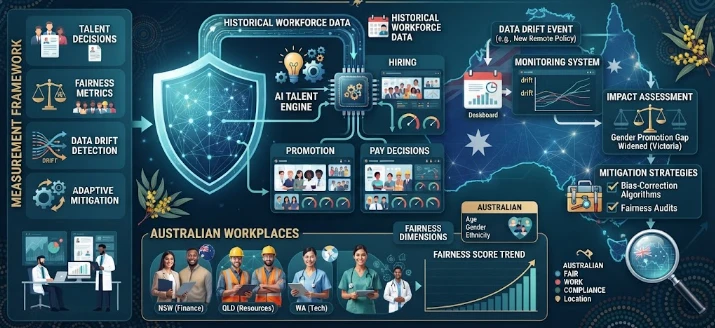
Talent decision fairness covers recruitment, promotion, performance management, development, scheduling, and related employment decisions, with particular attention to proxies, subgroup outcomes, accessibility, and calibration. The article distinguishes data drift from concept drift and separates model quality from decision quality. It favors temporal validation, subgroup monitoring, statistical drift signals interpreted with business context, and pre-defined triggers for recalibration, retraining, human escalation, or temporary suspension. The Australian discussion connects AI use with Privacy Act obligations, anti-discrimination responsibilities, human oversight, and concerns about unfair outcomes from biased data, proxies, or design choices. Across the analysis, business value is tied to baselines, uncertainty, subgroup effects, workflow fit, lifecycle cost, vendor accountability, scenario testing, and decision records. The overall message is that analytical performance becomes credible only when it improves real decisions under clearly defined operating and governance conditions. Independent review, common metric definitions, and periodic challenge exercises are also presented as safeguards against hidden deterioration, stale assumptions, and continued use of systems that no longer justify their cost or risk.
In Australia, talent decision fairness shifted from specialist analytics conversation to a management conversation by 23 June 2026. Central question was not whether a model could be built to come up with scores, forecasts, rankings, or recommendations. The focus shifted to how secure, comprehensible, equitable, and productive such outputs were when hooked up to actual decisions. The shift has changed the definition of success in terms of implementation for organizations that invest in talent decision fairness from simply achieving the desired technical outcomes to demonstrating the quality of the decisions made. Talent decision fairness encompasses the entire range of talent decisions from recruitment to promotion, performance measurement, development, scheduling, and more.
Fairness cannot be simplified to one measure of hiring because there is a distinct exposure to disadvantage at different phases. Australian workplaces also need to take into account whether model features are proxies for protected characteristics or socioeconomic circumstances. Group metrics, checks for calibration, a review on accessibility, and a qualitative assessment can detect risks that are not captured by aggregation accuracy. The significance of data drift is that a model may be technically available, but become economically useless. Changes in customer mix, the composition of the workforce, sensor behaviour, prices, channels or operating routines will alter input distributions. There is a deeper problem that the concept drift introduces, namely that the relationships between the predictors and the outcomes can also drift.
Therefore, decision-aware measurement requires observation of both predictive behavior and downstream quality of the decisions (predictions) produced from predictive behavior. The quality of the model is distinct from decision quality in a practical measurement architecture. Prediction behavior is measured by accuracy, calibration, ranking performance, residual patterns, and subgroup stability; and decision outcomes are measured by profit, service levels, fairness, delay, safety, or resource efficiency. There is a trade-off between predictive accuracy and the level of robustness of decision thresholds, and a small reduction in the predictive accuracy is not necessarily harmful. For a small distribution shift, a small cost can become high when there is a concentration around some critical threshold.
The combination of statistical alarms with business context should be the basis of drift detection. Population stability measures, divergence statistics, feature-range checks, missingness patterns and residual monitoring can warn of unusual movement, but the alerts must be interpreted. Expected shifts can result from seasonal demand, a new hiring campaign, sensor software changes, or customer segmentation changes. The stronger the monitoring, the more each alert is connected to a documented operational change hypothesis. There should be temporal discipline too in measurement. Random train-test splits can often be overoptimistic when deployment conditions change over time. Rolling validation, forward chaining, out-of-time holdouts, champion-challenger comparisons, and stress scenarios provide more evidence of future resilience.
All measures of performance should be monitored within relevant subgroups and within operational regimes, and not by averaging. The decision-aware monitoring doesn't end at dashboards. Action thresholds for retraining, recalibration, human escalation or temporary suspension should be established prior to any signs of severe deterioration. Every trigger has an owner, an expected response, and a record of the response. These controls transform model monitoring from a reactive process to an active risk management process. Australian bodies continued to carry out anti-discrimination responsibilities and privacy responsibilities, and there was a national discussion on more robust protection for high impact AI. In 2024, the Office of the Australian Information Commissioner clarified its interpretation of the Privacy Act in the context of AI products, particularly those that rely on personal information, and emphasized privacy governance.
The Australian Human Rights Commission also drew attention to issues around discrimination in algorithm-based decision making systems and to recruiters by releasing recruitment-specific compliance guidance. Communication of uncertainty is also crucial for strong analytical practice. Point estimates can provide false precision, particularly if there are few data points or if the data changes rapidly. Uncertainty is visible to operational teams through prediction intervals, sensitivity intervals, scenario analysis and confidence categories. Eliminating "don't know" language allows for proportional responses instead of automatic acceptance of all scores. Equally, vendor governance must be taken into account, as external platforms can impact the model, interface, data handling or terms without keeping pace with the pace of internal release.
Documentation, change notification, auditing access, incident response, security, data retention and exit procedures should all be included within contracts. Although vendor assurance may not replace the body of evidence gathered in-house, it is good to have the internal teams validate the assurance. The value of business should be considered throughout the business's life cycle. Development cost is just the start and integration, training, monitoring, data maintenance, review time, remediation and retirement use up resources as well. Those costs should be compared to the benefits. A model that requires frequent manual intervention can be good looking in a pilot run, and under-perform on the farm. A key driver of the benefits of organizational learning is the ability to monitor results and have them feed back into the design of the process.
When there is recurring discrepancies between data and front line judgment, then variables or rules may be missing or stale. If the model errors occur, they can identify issues with labels or in the business definition. Rather than just training on schedule, we can use those signals as learning opportunities and thus build a more robust decision system. Evidence should also be broken down by business unit, customer group, geography, channel and/or operating regime when those divisions have an impact on the fairness of talent decisions. Data dictionaries and common metric definitions eliminate disagreements that may only occur when performance is already declining. Base-line comparisons are always necessary because it is possible that the impression of improved fairness for talent decisions could vanish once the seasonal variation, policy changes, or previous trends are factored in.
It is helpful for reviewers to be able to reconstruct important results from raw inputs, documented assumptions, and version controlled code or model artifacts from the source. Operational teams don't need to rely on a long list of indicators, some of which may be irrelevant, but they do need to have a limited number of indicators relevant to decisions that have a clear set of escalation rules. This is where scenario testing can reveal brittle behavior prior to deployment, as it will push systems into rare combinations, missing inputs, sudden volume transitions or unusual scenarios. Data dictionaries and common-minded definitions of metrics prevent miscommunication that can only be identified when performance starts to drop.
Average performance as well as outcomes at the tail end also should be monitored – a large error can be more important than a small error in the average. Independent review is best used when reviewers can independently replicate key results from raw inputs, documented assumptions, and version-controlled model artifacts and/or code. Feedback from the frontline users is also important for change management because the friction in the workflow will negatively affect the realized value even if analytical performance is steady. Brilliant behavior can be discovered before deployment by pushing systems with rare input combinations, missing input, abrupt volume fluctuations, or unusual cases. The importance of having a clear retirement rule is that old models can remain in place for an extended period of time, even though ample evidence exists that they are no longer useful.
The monitoring should include an average performance, as well as tail outcomes because big mistakes have a higher significance than small changes in the mean statistic. The decision log provides useful supporting evidence for future audit purposes as it relates recommendations, overrides, contextual reasons and achieved outcomes. Feedback from the frontline users should also be included in change management, because workflow friction can impact the value delivered, even if analytical performance is consistent. Cost sensitive evaluation adds realism in assigning different consequences for false positive, false negative, delayed action and unnecessary escalation. A clear retirement rule is important because old models can remain in place in the organization even when it is clear they need to be replaced.
When a simpler rule or updated baseline or alternative model can outperform the current system, periodic challenge exercises can assess whether this is the case. Decision logs can be used to provide useful evidence for review in the future, including recommendations, overrides, contextual reasons and the outcomes. Evidence should also be broken down by business unit, customer group, geography, channel or operating regime, if there are divisions that impact fairness of the decisions regarding talent. Cost sensitive evaluation makes it more realistic by differentiating the consequences of false positive, false negative, delayed action, and unnecessary escalation. It is important to make baseline comparisons because improvements in the fairness of talent decisions may be apparent, but masked by the impact of seasonal trends, policy changes, or prior patterns.
The most effective way to promote fairness of talent decisions in Australia is to have continuous measurement linked to actual decisions. Drift should not be considered a failure but rather an operating condition. Companies that have temporal validation, business metrics, subgroup analysis, unambiguous triggers and responsible action processes can spot the beginning of the deterioration before the small statistical differences translate to large operational losses.
CITE THIS ARTICLE
CHOWDHURY, S. A. (2026). Measuring Talent Decision Fairness Under Data Drift in Australian Workplaces. https://www.sabbirresearchhub.com/article/d43e3174-8715-5290-9515-2d1dfe76683b
S. A. CHOWDHURY, “Measuring Talent Decision Fairness Under Data Drift in Australian Workplaces,” 2026. [Online]. Available: https://www.sabbirresearchhub.com/article/d43e3174-8715-5290-9515-2d1dfe76683b
CHOWDHURY, S. A. (2026) ‘Measuring Talent Decision Fairness Under Data Drift in Australian Workplaces’. Available at: https://www.sabbirresearchhub.com/article/d43e3174-8715-5290-9515-2d1dfe76683b
CHOWDHURY, SABBIR AHMED. “Measuring Talent Decision Fairness Under Data Drift in Australian Workplaces.” 2026, https://www.sabbirresearchhub.com/article/d43e3174-8715-5290-9515-2d1dfe76683b.
SABBIR AHMED CHOWDHURY. “Measuring Talent Decision Fairness Under Data Drift in Australian Workplaces.” (2026). https://www.sabbirresearchhub.com/article/d43e3174-8715-5290-9515-2d1dfe76683b.
CHOWDHURY SA. Measuring Talent Decision Fairness Under Data Drift in Australian Workplaces. 2026. https://www.sabbirresearchhub.com/article/d43e3174-8715-5290-9515-2d1dfe76683b
@misc{article_d43e31748715529095152d1dfe76683b,
  title = {Measuring Talent Decision Fairness Under Data Drift in Australian Workplaces},
  author = {SABBIR AHMED CHOWDHURY},
  year = {2026},
  url = {https://www.sabbirresearchhub.com/article/d43e3174-8715-5290-9515-2d1dfe76683b},
}
TY  - GEN
AU  - SABBIR AHMED CHOWDHURY
TI  - Measuring Talent Decision Fairness Under Data Drift in Australian Workplaces
PY  - 2026-06-23
UR  - https://www.sabbirresearchhub.com/article/d43e3174-8715-5290-9515-2d1dfe76683b
ER  -
AI-enabled employee engagement includes survey analytics, sentiment analysis, personalized recommendations, workforce listening, communication tools, and manager decision support, all operating within sensitive employment relationships. The article compares humans and algorithms on matched tasks, information, and outcome horizons rather than benchmark scores alone. Human context and judgment are weighed against algorithmic scale and repeatability, while hybrid rules, disagreement analysis, blind
This article compares human and algorithmic decision making for Omnichannel Attribution in Canadian Markets, focusing on downstream decision quality rather than prediction accuracy alone. It estimates how online and offline touchpoints contribute to conversion, while identity gaps, walled-garden platforms and the difference between observed credit and causal incrementality complicate interpretation. Human judgment contributes context, tacit knowledge, strategic interpretation and sensitivity to
AI business model renewal concerns changes in value creation, value delivery, and value capture through AI-enabled services, workflow redesign, personalization, pricing support, and new information products. The article emphasizes real-world causal testing through random assignment, phased rollouts, encouragement designs, or cluster experiments. It calls for pre-specified outcomes, contamination controls, comparisons among human-only, algorithm-only, and hybrid workflows, and stop rules when har