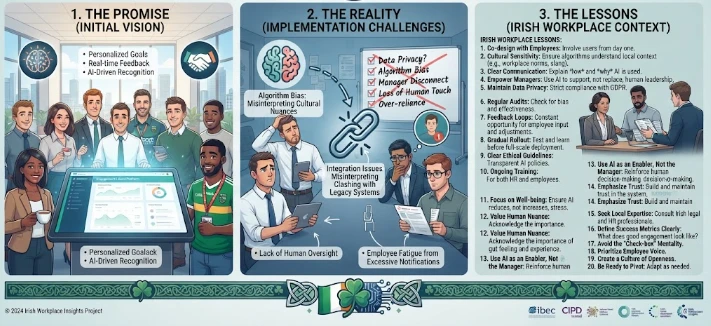
AI-enabled employee engagement includes survey analytics, sentiment analysis, personalized recommendations, workforce listening, communication tools, and manager decision support, all operating within sensitive employment relationships. The article shows how implementation can fail even when the model still operates. Data fragmentation, proxy metrics, workflow friction, unclear ownership, and misaligned incentives can disconnect analytics from value, so baseline comparisons, balanced measures, independent validation, and post-implementation review become central. The Irish discussion sits within GDPR, the EU AI Act, and wider European platform and data-protection rules, making transparency, lawful processing, human oversight, and trust operational concerns. Across the analysis, business value is tied to baselines, uncertainty, subgroup effects, workflow fit, lifecycle cost, vendor accountability, scenario testing, and decision records. The overall message is that analytical performance becomes credible only when it improves real decisions under clearly defined operating and governance conditions. Independent review, common metric definitions, and periodic challenge exercises are also presented as safeguards against hidden deterioration, stale assumptions, and continued use of systems that no longer justify their cost or risk.
In Ireland by 19 May 2026, AI had shifted from a specialist analytics to a wider management discussion. The question was not whether advanced models could score, forecast, rank or recommend, but rather whether they could be used as tools for decision making.The focus was no longer on whether advanced models could score, forecast, rank or recommend, but whether they could be used as decision making tools. The focus was now on how reliable, understandable, fair and economical those outputs were when integrated into real decisions. It redefined ‘successful implementation' from performance of the AI to quality of decisions based on evidence for organisations that invest in AI-powered employee engagement.
Employee engagement analytics, sentiment analysis, personalized recommendations, communication tools, workforce listening, and manager decision support are all examples of how AI can be applied to employee engagement. Every application is located in an area of delicate working relationships; there can be no complete standard of accuracy. Irish workplaces are already subject to GDPR requirements on the use of personal data, and will now be subject to changing EU regulations on AI. The implications of employee trust, consultation, transparency and proportionality are therefore important as to whether engagement technology is likely to foster positive engagement or a negative response. Implementation failure does not typically start with an epic model failure. Typically, the value is lost due to poor data joins, fuzzy ownership, vague goals, disjointed processes, and dashboards that are out of sync with real decisions.
It's possible for a technically impressive system to fail even though all parts seem to be working. Failure analysis should track the entire journey of obtaining the data to take action at the organizational level. One of the possible causes is data fragmentation. There is nothing inherent in the activity itself that results in multiple identifiers, timestamps, taxonomies, or definitions being assigned to the activity by different channels, teams, vendors, or workplace systems. Integration errors in turn become behavioral insight. These are basic controls that are disproportionately impactful: data lineage, reconciliation tests, missingness analysis and shared definitions. A second failure pattern is when a proxy metric is made the objective.
Once optimization begins, engagement, attributing credit, sentiment, clicks, or conversion probability may lose their relationship to a lasting business value. As customer trust, employee experience or long term outcomes decline, teams make improvements to the measured proxy. Balanced scorecards mitigate that risk by merging the short-term indicators with the long-term indicators. When workflows aren't redesigned, organization adoption can also break down when automation comes. Staff have additional warnings, two sets of systems, conflicting instructions and not much clarity on what to do. Low adoption is then attributed to resistance, when they are really rational reasons to avoid it. Successful implementation eliminates unnecessary steps and decision rights. Incentives should be as thoroughly reviewed as algorithms in failure scenarios.
Vendors can maximize their chances of renewal, departments justify control of budget, managers can prefer easily seen activity and analysts can argue their support of models created by known people. If the incentives have been made independent and their success criteria explicitly specified, distance will be created. Promise vs measured value, based on original baseline, should be compared for post-implementation reviews. Irish organisations operated in the rapidly changing landscape of AI and data-protection regulations in the EU, and GDPR was already in play whenever personal data was involved in an AI's development or deployment. The EU AI Act has come into effect in August 2024, and established a risk-based approach with limited practices and comprehensive obligations regarding high-risk AI systems.
In the process, some of the prohibited uses of the AI and AI-literacy requirements began in early 2025, and others were still yet to come. Explicit uncertainty communication is also crucial for strong analytical practice. Point estimates can generate misperceptions of precision when there are limited data points or rapid fluctuations. Uncertainty is visible to the operational teams through the use of prediction intervals, sensitivity ranges, scenario analysis and confidence categories. Remove ambiguity language to allow proportional responses instead of automatic responses for all scores. There is an equal need to pay attention to the vendor governance since external platforms may change models, interfaces, data processing or terms without the same release cycles as the internal ones.
Documentation, notification of changes, access to audits, incident responses, security, data retention, and exit procedures should be covered in the contract. The internal teams also need to be independently validated as vendor assurance does not replace organisation-specific evidence. The value of businesses should be assessed for the entire business life cycle. Development cost is not the only resource that is used, integration, training, monitoring, data maintenance, review time, remediation and retirement are also resources. The benefits should be compared with those of the on-going costs. A model that has to be continually hand tuned may present a spectacular picture in a pilot but fail to deliver good net value once scaled up.
When the results of the monitoring process are fed back into the design of the process, organizational learning becomes a significant source of returns. When there are inconsistencies between data and front-line judgment, it can uncover missing variables, or rules that are out of date. A series of model errors may uncover problems with the labels or business definition. By using those signals as learning opportunities, it's creating a better decision system than just retraining on schedule. Business unit, customer group, geography, channel and operating regime should also be included as segments when they have an impact on AI enabled employee engagement. Shared metric definitions and data dictionaries minimize disagreements that can only be heard when performance is starting to fall off.
Comparing with baseline is crucial as improvements in employee engagement may simply be due to a change in season, a policy change or a previous trend. Independent review is best performed when reviewers are able to reproduce the key results, from raw inputs, documented assumptions and version controlled code or model artifacts. Instead of a large dashboard without any clear escalation logic, operational teams are equipped with a small set of indicators that are relevant to the decision. Deploying to verify your system works as expected might fail in the presence of rare combinations, missing inputs, sudden volume fluctuations, or the unknown. Scenario testing can reveal brittle behavior before deployment by presenting the system with unusual circumstances, combinations, or inputs.
Having agreed-upon data definitions and shared metric definitions helps prevent disagreements that can only be identified when things start to go wrong with performance. Average statistics and tail statistics need to be monitored as both types of performance errors can be severe. Independent review is best performed when reviewers are able to reproduce the key results, from raw inputs, documented assumptions and version controlled code or model artifacts. Feedback from frontline users is also necessary in change management, as workflow friction may make it less likely that the value of the analysis will be actually realized, even if the performance remains the same. The purpose of scenario testing is to simulate adversarial scenarios prior to deployment, to uncover brittle behaviour and identify unexpected combinations, missing inputs, sudden volume changes, or unusual situations.
The importance of a clear retirement rule is that old models can remain in place in organisations for a long time after evidence has indicated that they should be replaced. Average performance and tail outcomes should both be monitored, as errors that can be severe might be more important than smaller gains in a mean statistic. Decision logs are a great tool for future reference for connecting recommendations, overrides, context and outcomes. Change management also requires feedback from users at the front line, because even in the event of stable analytical performance, the friction of the workflow can have an impact on the value realized. When the consequences of false positive and false negative results, delayed action, and unnecessary escalation vary, this process is considered cost sensitive evaluation, which brings a level of realism.
The importance of a clear retirement rule is that old models can remain in place in organisations for a long time after evidence has indicated that they should be replaced. Periodic challenge exercises can be used to determine if a simpler rule or baseline or alternative model can better hold up to the incumbent system. Decision logs provide a beneficial document of evidence to review later that connects recommendations, overrides, context, and outcomes. Additionally, evidence should be broken down by business unit, customer, geography, channel or operating regime if they impact employee engagement through the use of AI. The cost sensitive evaluation is more realistic since the consequences of false positive, false negative, delayed action and unnecessary escalation are different.
Baseline comparisons are critical since the perceived increase in AI's role in employee engagement may be erased once seasonal fluctuations, policy adjustments, or other factors are considered. Employee engagement in Ireland is most often a systemic issue with AI, not just technical. A combination of clean data, realistic objectives, aligned incentives, usable workflows and evidence that modeled signals correlate to real value is all required for better outcomes. Having more projects survive due to implementation discipline is better than having more layers of algorithmic complexity.
CITE THIS ARTICLE
CHOWDHURY, S. A. (2026). When AI Enabled Employee Engagement Fails: Implementation Lessons from Irish Workplaces. https://www.sabbirresearchhub.com/article/731e6e65-1f95-5e88-9f74-e2eed2a5bfae
S. A. CHOWDHURY, “When AI Enabled Employee Engagement Fails: Implementation Lessons from Irish Workplaces,” 2026. [Online]. Available: https://www.sabbirresearchhub.com/article/731e6e65-1f95-5e88-9f74-e2eed2a5bfae
CHOWDHURY, S. A. (2026) ‘When AI Enabled Employee Engagement Fails: Implementation Lessons from Irish Workplaces’. Available at: https://www.sabbirresearchhub.com/article/731e6e65-1f95-5e88-9f74-e2eed2a5bfae
CHOWDHURY, SABBIR AHMED. “When AI Enabled Employee Engagement Fails: Implementation Lessons from Irish Workplaces.” 2026, https://www.sabbirresearchhub.com/article/731e6e65-1f95-5e88-9f74-e2eed2a5bfae.
SABBIR AHMED CHOWDHURY. “When AI Enabled Employee Engagement Fails: Implementation Lessons from Irish Workplaces.” (2026). https://www.sabbirresearchhub.com/article/731e6e65-1f95-5e88-9f74-e2eed2a5bfae.
CHOWDHURY SA. When AI Enabled Employee Engagement Fails: Implementation Lessons from Irish Workplaces. 2026. https://www.sabbirresearchhub.com/article/731e6e65-1f95-5e88-9f74-e2eed2a5bfae
@misc{article_731e6e651f955e889f74e2eed2a5bfae,
  title = {When AI Enabled Employee Engagement Fails: Implementation Lessons from Irish Workplaces},
  author = {SABBIR AHMED CHOWDHURY},
  year = {2026},
  url = {https://www.sabbirresearchhub.com/article/731e6e65-1f95-5e88-9f74-e2eed2a5bfae},
}
TY  - GEN
AU  - SABBIR AHMED CHOWDHURY
TI  - When AI Enabled Employee Engagement Fails: Implementation Lessons from Irish Workplaces
PY  - 2026-05-19
UR  - https://www.sabbirresearchhub.com/article/731e6e65-1f95-5e88-9f74-e2eed2a5bfae
ER  -
AI-enabled employee engagement includes survey analytics, sentiment analysis, personalized recommendations, workforce listening, communication tools, and manager decision support, all operating within sensitive employment relationships. The article compares humans and algorithms on matched tasks, information, and outcome horizons rather than benchmark scores alone. Human context and judgment are weighed against algorithmic scale and repeatability, while hybrid rules, disagreement analysis, blind
This article compares human and algorithmic decision making for Omnichannel Attribution in Canadian Markets, focusing on downstream decision quality rather than prediction accuracy alone. It estimates how online and offline touchpoints contribute to conversion, while identity gaps, walled-garden platforms and the difference between observed credit and causal incrementality complicate interpretation. Human judgment contributes context, tacit knowledge, strategic interpretation and sensitivity to
AI business model renewal concerns changes in value creation, value delivery, and value capture through AI-enabled services, workflow redesign, personalization, pricing support, and new information products. The article emphasizes real-world causal testing through random assignment, phased rollouts, encouragement designs, or cluster experiments. It calls for pre-specified outcomes, contamination controls, comparisons among human-only, algorithm-only, and hybrid workflows, and stop rules when har