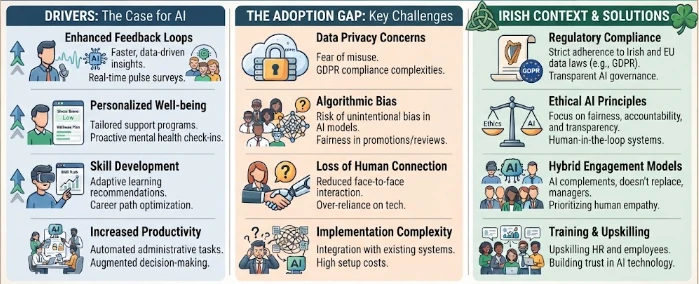
AI-enabled employee engagement includes survey analytics, sentiment analysis, personalized recommendations, workforce listening, communication tools, and manager decision support, all operating within sensitive employment relationships. The article explains adoption gaps through organizational capability rather than enthusiasm alone. Data maturity, infrastructure, governance, privacy processes, leadership support, incentives, switching costs, and local evidence determine whether advanced analytics can move from pilot use to sustained operating practice. The Irish discussion sits within GDPR, the EU AI Act, and wider European platform and data-protection rules, making transparency, lawful processing, human oversight, and trust operational concerns. Across the analysis, business value is tied to baselines, uncertainty, subgroup effects, workflow fit, lifecycle cost, vendor accountability, scenario testing, and decision records. The overall message is that analytical performance becomes credible only when it improves real decisions under clearly defined operating and governance conditions. Independent review, common metric definitions, and periodic challenge exercises are also presented as safeguards against hidden deterioration, stale assumptions, and continued use of systems that no longer justify their cost or risk.
By 12 MAy 2026, AI had taken employee engagement from being a specialist analytics discussion to a management one in Ireland. The question was not whether advanced models could score, forecast, rank or recommend, but rather whether they could be used as tools for decision making.The focus was no longer on whether advanced models could score, forecast, rank or recommend, but whether they could be used as decision making tools. The focus was now on how reliable, understandable, fair and economical those outputs were when integrated into real decisions. It redefined ‘successful implementation' from performance of the AI to quality of decisions based on evidence for organisations that invest in AI-powered employee engagement.
Survey analytics, sentiment analysis, personalization, communication, listening to the workforce, and supporting managers in decision making are examples of AI-powered employee engagement. Every one of these applications is near very delicate working relationships; accuracy is not sufficient. Irish workplaces are already subject to GDPR requirements on the use of personal data, and will now be subject to changing EU regulations on AI. Therefore, employee trust, consultation, transparency and proportionality all impact the potential of engagement technology to produce meaningful engagement or a defensive response. The gap in adoptions can be because of the difference in capabilities and not just a lack of enthusiasm of technology. Large companies can invest in data engineering, experimentation, governance, and in hiring specialists, while smaller companies may rely on packaged solutions and external platforms.
There is also a difference in sectors, as transaction frequencies, data richness, regulations and customer journeys vary widely from industry to industry. The two factors are digital maturity and the expected value and the implementation cost. Advanced models can be applied to organizations that have unique identifiers, integrated systems, reliable tracking of events and have a workflow for analytics. First, there needs to be basic infrastructure work done in fragmented organisations. The price of an analytical tool thus undermines the actual price of readiness. When adopting demands for changes in incentives and decision rights, leadership support is important. New analytical capability poses a threat to existing knowledge, vendor collaborations, cost control, or management authority.
Senior sponsorship can create a path forward, but can also propel a prematurely scaled out. Strategic commitment meets evidence gates in effective leadership. Another split is in terms of privacy and governance capability. Advanced analytics can be evaluated with greater confidence in firms where consensus processes are more advanced, data inventories are available, retention rules are established, access is controlled and vendors are monitored. Companies without those foundations have more risk with regards to lawful data usage and reputational risks. Governance maturity can, in this way, contribute to the speed up of responsible adoption instead of stifling experimentation. What matters for perceived usefulness is that there is an actual improvement that can be measured.
Initial interest can be generated via demonstrations and vendor benchmarks, but evidence of local data and real workflows is imperative for sustained adoption. Pilot programs should be designed to set baselines, compare options, determine effort to implement, and determine failure modes. Rationality of adoption occurs when expected value is greater than switching cost and residual risk. Irish organisations operated in the rapidly changing European landscape for AI and data protection within the European Union, where GDPR framework already applied when personal data was involved in AI development and/or deployment. The EU AI Act was enacted in August 2024, containing a risk-based approach, limits on specific practices and specific obligations for high-risk systems.
By early 2025, some of the regulatory deadlines were starting to arrive, as the prohibited AI practices and AI-literacy requirements began. Uncertainty communication is also necessary for good analytical practice. Point estimates can lead to false precision, particularly if there is limited data coverage or conditions are highly dynamic. Uncertainty is visible to the operational teams through the use of prediction intervals, sensitivity ranges, scenario analysis and confidence categories. Remove ambiguity language to allow proportional responses instead of automatic responses for all scores. Equally important is the governance of the vendors, as external platforms can change models, interfaces, data processing, and/or terms at a pace that does not match that of the internal model.
Documentation, notification of changes, access to audits, incident responses, security, data retention, and exit procedures should be covered in the contract. The independent validation of internal teams is required as vendor assurance is no substitute for evidence from the organization. Business value needs to be assessed throughout a business lifecycle. The development cost is just the first in a long list of resources required for integration, training, monitoring, data maintenance, review time, remediation and retirement. Those benefits need to be weighed against those recurring costs. A model that has to be continually hand tuned may present a spectacular picture in a pilot but fail to deliver good net value once scaled up.
When the results of the monitoring process are fed back into the design of the process, organizational learning becomes a significant source of returns. When there are inconsistencies between data and front-line judgment, it can uncover missing variables, or rules that are out of date. Common mistakes in labels or business definitions can be found by making repeated mistakes with the model. This use of those signals as learning opportunities builds the decision system more effectively than just training on schedule. Evidence should also be broken down by business unit, customer group, geography, channel or operating regime if they have an impact on employee engagement via AI. Shared metric definitions and data dictionaries minimize disagreements that can only be heard when performance is starting to fall off.
Without baseline comparisons, it will be impossible to determine whether any apparent improvement in employee engagement is really due to AI or is more likely a result of seasonal shifts or changes in a company's policies or previous performance. Independent review is best performed when reviewers are able to reproduce the key results, from raw inputs, documented assumptions and version controlled code or model artifacts. The operational teams get a small number of indicators that are relevant for the decision, instead of the big dashboard with no reason for escalation. Use scenario testing to reveal brittle behaviour in systems before deployment by sending them rare combinations, missing inputs, sudden volume changes and unknown scenarios.
Shared metric definitions and data dictionaries minimize disagreements that can only be heard when performance is starting to fall off. Monitoring should be done both on average performance and tail outcomes as the former are less important than the latter if a significant error occurs. Independent review is best performed when reviewers are able to reproduce the key results, from raw inputs, documented assumptions and version controlled code or model artifacts. Change management must also incorporate feedback from frontline users because even if the analytical performance does not change, workflow friction can impact realized value. Usually brittle behavior is only discovered after deployment, when a combination of rare events, missing inputs, rapid volume changes or unfamiliar cases occur; scenario testing can reveal this brittle behavior prior to the deployment.
The importance of a clear retirement rule is that old models can remain in place in organisations for a long time after evidence has indicated that they should be replaced. Average performance and tail performance should both be monitored as severe errors tend to be more important than minor changes in the mean statistic. Decision logs provide important evidence that can be referred to subsequently and may connect recommendations, overrides, context and outcomes. Feedback from the frontline users is also essential to change management as workflow friction can diminish actual value when analytical performance is consistent. The cost sensitive evaluation is more realistic since the consequences of false positive, false negative, delayed action and unnecessary escalation are different.
The importance of a clear retirement rule is that old models can remain in place in organisations for a long time after evidence has indicated that they should be replaced. Periodic challenge exercises might be used to determine whether the simpler rule, new baseline and/or alternative model are better than the existing system. Decision logs provide useful evidence for analysis and review later on, because they connect recommendations and overrides, and explain the reasons and the consequences of decisions. Evidence should also be broken down by business unit, customer group, geography, channel or operating regime if they have an impact on employee engagement via AI. The cost sensitive evaluation is more realistic since the consequences of false positive, false negative, delayed action and unnecessary escalation are different.
The reason for this is that when seasonal trends, policy changes, or prior trends are accounted for, the improvement in employee engagement that appears in the apparent improvement in AI can disappear. Periodic challenge exercises can be used to determine if a simpler rule or baseline or alternative model can better hold up to the incumbent system. A limited number of indicators instead of a large dashboard with no logic of escalation. AI readiness, incentives, governance and evidence will contribute to the adoption gap as well as technology availability, with regard to employee engagement across Ireland. Established firms that have integrated data into their operations, have a high level of operating discipline, are privacy mature and have measurable pilot results have a structural advantage.
The journey of sustainable adoption starts with capability building and grows only when there is local evidence to support its growth.
CITE THIS ARTICLE
CHOWDHURY, S. A. (2026). Explaining Adoption Gaps in AI Enabled Employee Engagement Across Irish Workplaces. https://www.sabbirresearchhub.com/article/21e36cf1-9abc-523e-ba63-5942c7f8b86c
S. A. CHOWDHURY, “Explaining Adoption Gaps in AI Enabled Employee Engagement Across Irish Workplaces,” 2026. [Online]. Available: https://www.sabbirresearchhub.com/article/21e36cf1-9abc-523e-ba63-5942c7f8b86c
CHOWDHURY, S. A. (2026) ‘Explaining Adoption Gaps in AI Enabled Employee Engagement Across Irish Workplaces’. Available at: https://www.sabbirresearchhub.com/article/21e36cf1-9abc-523e-ba63-5942c7f8b86c
CHOWDHURY, SABBIR AHMED. “Explaining Adoption Gaps in AI Enabled Employee Engagement Across Irish Workplaces.” 2026, https://www.sabbirresearchhub.com/article/21e36cf1-9abc-523e-ba63-5942c7f8b86c.
SABBIR AHMED CHOWDHURY. “Explaining Adoption Gaps in AI Enabled Employee Engagement Across Irish Workplaces.” (2026). https://www.sabbirresearchhub.com/article/21e36cf1-9abc-523e-ba63-5942c7f8b86c.
CHOWDHURY SA. Explaining Adoption Gaps in AI Enabled Employee Engagement Across Irish Workplaces. 2026. https://www.sabbirresearchhub.com/article/21e36cf1-9abc-523e-ba63-5942c7f8b86c
@misc{article_21e36cf19abc523eba635942c7f8b86c,
  title = {Explaining Adoption Gaps in AI Enabled Employee Engagement Across Irish Workplaces},
  author = {SABBIR AHMED CHOWDHURY},
  year = {2026},
  url = {https://www.sabbirresearchhub.com/article/21e36cf1-9abc-523e-ba63-5942c7f8b86c},
}
TY  - GEN
AU  - SABBIR AHMED CHOWDHURY
TI  - Explaining Adoption Gaps in AI Enabled Employee Engagement Across Irish Workplaces
PY  - 2026-05-12
UR  - https://www.sabbirresearchhub.com/article/21e36cf1-9abc-523e-ba63-5942c7f8b86c
ER  -
AI-enabled employee engagement includes survey analytics, sentiment analysis, personalized recommendations, workforce listening, communication tools, and manager decision support, all operating within sensitive employment relationships. The article compares humans and algorithms on matched tasks, information, and outcome horizons rather than benchmark scores alone. Human context and judgment are weighed against algorithmic scale and repeatability, while hybrid rules, disagreement analysis, blind
This article compares human and algorithmic decision making for Omnichannel Attribution in Canadian Markets, focusing on downstream decision quality rather than prediction accuracy alone. It estimates how online and offline touchpoints contribute to conversion, while identity gaps, walled-garden platforms and the difference between observed credit and causal incrementality complicate interpretation. Human judgment contributes context, tacit knowledge, strategic interpretation and sensitivity to
AI business model renewal concerns changes in value creation, value delivery, and value capture through AI-enabled services, workflow redesign, personalization, pricing support, and new information products. The article emphasizes real-world causal testing through random assignment, phased rollouts, encouragement designs, or cluster experiments. It calls for pre-specified outcomes, contamination controls, comparisons among human-only, algorithm-only, and hybrid workflows, and stop rules when har