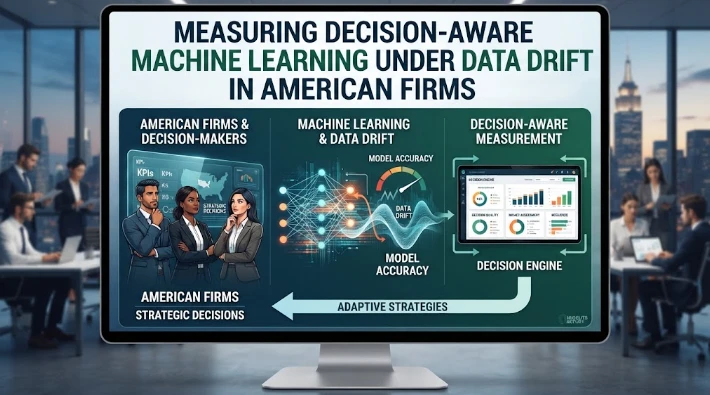
By 18 August 2026, decision-aware machine learning had evolved from an analyst discussion to a management question in the United States. The problem was no longer whether the advanced models could produce scores, forecasts, rankings or recommendations. The focus shifted to how those outputs were reliable, understandable, fair and economically useful when linked to real decisions. For organisations that are committed to investing in decision-aware machine learning, the change brought the concept of success from just technical performance to proof-based decision quality.
The decision-aware approach to machine learning does not view prediction as the end goal, but as a means to an end. This is important because despite the same accuracy, there could be significant differences in business outcomes depending on thresholds, resource limits, and costs associated with errors. American companies, then, benefit from learning from connecting modeling results with real consequence, decisions made, behavior overridden, and varying operating conditions, more than they do from celebrating a single benchmark score.
Data drift is an issue because a model may be technically viable, but economically not viable. When the mix of customers, the composition of the workforce, sensor behaviour, prices, channel and/or the operating routines change, input distributions shift. The problem is compounded by the occurrence of concept drift – that is, the relationships between predictors and outcomes can change as well. So, decision-aware measurement must be able to capture predictive behavior as well as the quality of the decisions made downstream of predictions.
The architecture of a practical measurement allows for the distinction between model quality and decision quality. Prediction behavior is characterized by accuracy, calibration, ranking performance, residual patterns, or subgroup stability, whereas decision outcomes are characterized by profit, service levels, fairness, delay, safety, or resource efficiency. Small errors in prediction may be inconsequential if decision thresholds are high. The cost of a small distribution shift can be significant if there is a concentration of cases near a critical threshold.
It is important to continuously detect drifts by incorporating statistical alarms and business context. Population stability measures, divergence statistics, feature-range checks, missingness patterns, and residual monitoring can be used to flag unusual movement, but need to be interpreted. Changes in seasonal demand, a new hiring campaign, new sensor firmware, or new customer categorization can generate expected changes. Each alert becomes stronger if connected to a documented hypothesis of an operational change.
Time management is also required for measurement. When deployment conditions change over the course of time, random train-test splits tend to overestimate confidence. The following are more indicators of future resilience: rolling validation, forward chaining, out-of-time holdouts, champion-challenger comparisons, and stress scenarios. Averages should not mask disproportionate performance across relevant subgroups and operational contexts.
Decision-aware monitoring isn't limited to dashboards. The points at which the training or calibration must be repeated, recalibrated, human escalated or temporarily suspended should be established in advance before severe deterioration occurs. Each trigger is accompanied by an owner, an anticipated response, and a record of the ensuing action. These controls transform monitoring of the model from a passive activity to an operational risk management measure.
AI governance in the U.S. has not been a monolithic entity, but a series of federal, consumer-protection, sector-specific, state, and local laws and policies, and has also been evolving throughout the middle of this decade. In 2023, NIST published the AI Risk Management Framework that focused on the four phases of Govern, Map, Measure, and Manage and explicitly identified data, model, and concept drift as reasons for maintaining AI. Employment technology received additional focus given that the EEOC had already pointed out that existing anti-discrimination laws apply when employee selection is affected by software, algorithms, or artificial intelligence.
Tacit uncertainty communication is also an integral part of good analytical practice. Point estimates can give the impression of excessive precision, particularly if data are sparse or conditions are rapidly evolving. Uncertainty is made visible to operational teams through prediction intervals, sensitivity ranges, scenario analysis and confidence categories. Remove ambiguity in language to enable proportional responses and not automatic acceptance of all scores.
As much as vendor governance should be paid attention to since outside platforms can change the models, interface, data processing, or terms without having an equal release cycle with the inside. Documentation, Change Notification, Audit Access, Incident Response, Security, Data Retention, Exit Plans should all be discussed. It will require independent validation from internal teams as vendor assurance is not a replacement for organization-specific validation.
Business value needs to be determined throughout the entire life cycle. The initial development time is the first of many costs associated with integrating, training, monitoring, data maintenance, review time, remediation, and retirement. The cost of those benefits should be compared with the costs that are recurring. A model that requires frequent manual effort to fix and maintain can be very nice in a pilot but will generate weak net value once scaled up.
Organizational learning becomes a critical source for return when the monitoring results are used for feed-back to process design. When data and frontline judgement flagrantly disagree, it can reveal the absence of a variable or perhaps old rules. Frequently, a variety of model mistakes can expose problems in labels or definitions of business. When those signals are treated as learning opportunities, a better decision system is developed than just a retraining program on schedule.
Evidence should also be broken down by business unit, customer segment, geography, channel, or operating regime, if those are likely to impact decision driven machine learning. Data dictionaries and metric definitions that are shared minimize disagreements that can only occur when performance starts to slip.
Comparisons against the baseline are essential because it is possible that the apparent improvement in decision-aware machine learning results from seasonal patterns, policy changes, or preexisting trends that are not considered. Independent review is most helpful when reviewers can reproduce key results from the raw data, documented assumptions, and artifacts of the model or code that are all version controlled.
Operational teams receive a few key indicators to make decisions and not a massive dashboard with no clear escalation logic. Rare inputs, missing inputs, sudden volume changes, and new scenarios can cause brittle behavior if it is identified before deployment.
Data dictionaries and common metric definitions minimize disagreements that typically occur once performance starts to decline. Average performance should be monitored along with tail outcomes since very large errors may result in more significant than minor movement in the mean.
Independent review is most valuable when reviewers are able to follow the key steps from the raw input to the final output and document their assumptions and when the code or model is version controlled. Feedback from the frontline users is also crucial for change management, as workflow friction can erode the value generated from analytics applications even at constant analytical performance.
Scenario testing can be used to reveal brittle behavior in a system before deployment, as it applies it to rare combinations, missing inputs, sudden volume changes, and other unusual cases. A clear retirement rule becomes important when there is organizational inertia that prevents the obsolescent models from being phased out even when evidence indicates that they should be.
Average performance measures and tail outcome measures should be monitored, as large mistakes can have more impact than small changes in a mean measure. Decision logs are a useful document to review in the future connecting recommendations, overrides, reasons in context, and actual outcomes.
Feedback from the frontline user is also crucial in change management; the value can be lost if the workflow is not smooth. Cost sensitive evaluation, where false positives, false negatives, delayed action and unnecessary escalation have different consequences, adds realism.
The reason a clear retirement rule is important is that organizations can continue to use out-of-date models after it has been established that they are no longer effective. Periodic challenge exercises can be used to determine if a simpler rule, a new baseline or another model would be more effective than the current one.
Decision logs can be very useful for future review, connecting recommendations, overrides, context and actual outcomes. Evidence should also be broken down by business unit, customer group, geography, channel or operating regime if these segments impact decision-aware machine learning.
Cost-sensitive evaluation enhances realism by assigning varying consequences to false positive, false negative, delayed action and unnecessary escalation. It is important to have a baseline measurement since there may be apparent improvements in decision-aware machine learning that are lost if considering seasonal trends, policy changes, or trends that occurred earlier.
The most promising direction for decision-aware machine learning in the United States is the continuous measurement that is aligned to real decisions. Drift should be regarded as a normal operating state, not fault. Those organizations that integrate temporal validation, business metrics, subgroup analysis, unambiguous triggers, and answerable response processes are able to identify degradation before the small changes in statistics are transformed into big losses in operation.